Skip to content
Savannah Foundation

Serving Savannah and nearby areas

Sloping and Sagging Floors in Savannah, GA

A sloping or sagging floor in Savannah usually means a support under the house has dropped or the wood has weakened, so get a free inspection and a written price to level it.

Book a free foundation inspection

Tell us what you are seeing. A local specialist calls you back the same business day.

Local to Savannah

We connect property owners in Savannah and nearby areas, including Historic District, Victorian District, Thomas Square and Midtown, Ardsley Park, Isle of Hope and Thunderbolt, with one independent local foundation repair specialist.

  • Hundred-year-old floors

    The Victorian District was built mostly from 1870 to 1910. Ardsley Park was laid out starting in 1909, and its U.S. historic record says every house in it is wood framed. Many of these floors have carried a family for a century.

  • Part of it built on a bog

    The Ardsley Park historic record says part of the neighborhood sits on a filled-in bog. Filled ground can keep settling for many years, and the piers on it can sink unevenly.

  • Wet ground under the piers

    The Chatham County plan calls the county flat, with soil that drains poorly and water close to the top. Soaked soil under a pier footing is softer, so the pier can slowly push down.

What it costs

Typical published ranges for Savannah. The contractor's written estimate is the price, and the inspection is free.

WorkTypical range
Floor and crawl space inspection with written estimate Free
Fix a sagging floor $1,000 to $5,000
Replace a floor joist $100 to $300each
Replace a support beam $1,500 to $5,000each
Pier and beam foundation repair, most jobs $2,000 to $15,000
Wood rot repair $750 to $5,000

See typical foundation repair prices in Savannah

How to tell your floor is sloping

Some slope is easy to spot. Some sneaks up on you. Here are the clues people in Savannah notice first.

A ball or marble rolls

To one side or into the middle of the room.

Furniture rocks

Or leans away from the wall.

A gap opens

Under the baseboard on one side.

Doors swing open or shut

On their own.

Cracks in the plaster

Run from the top corners of doors.

The floor feels bouncy

Or soft when you walk across it.

Tile cracks

In a line across the kitchen or bath.

You feel it walking

Down a hall, like a slight hill.

Why floors slope in Savannah homes

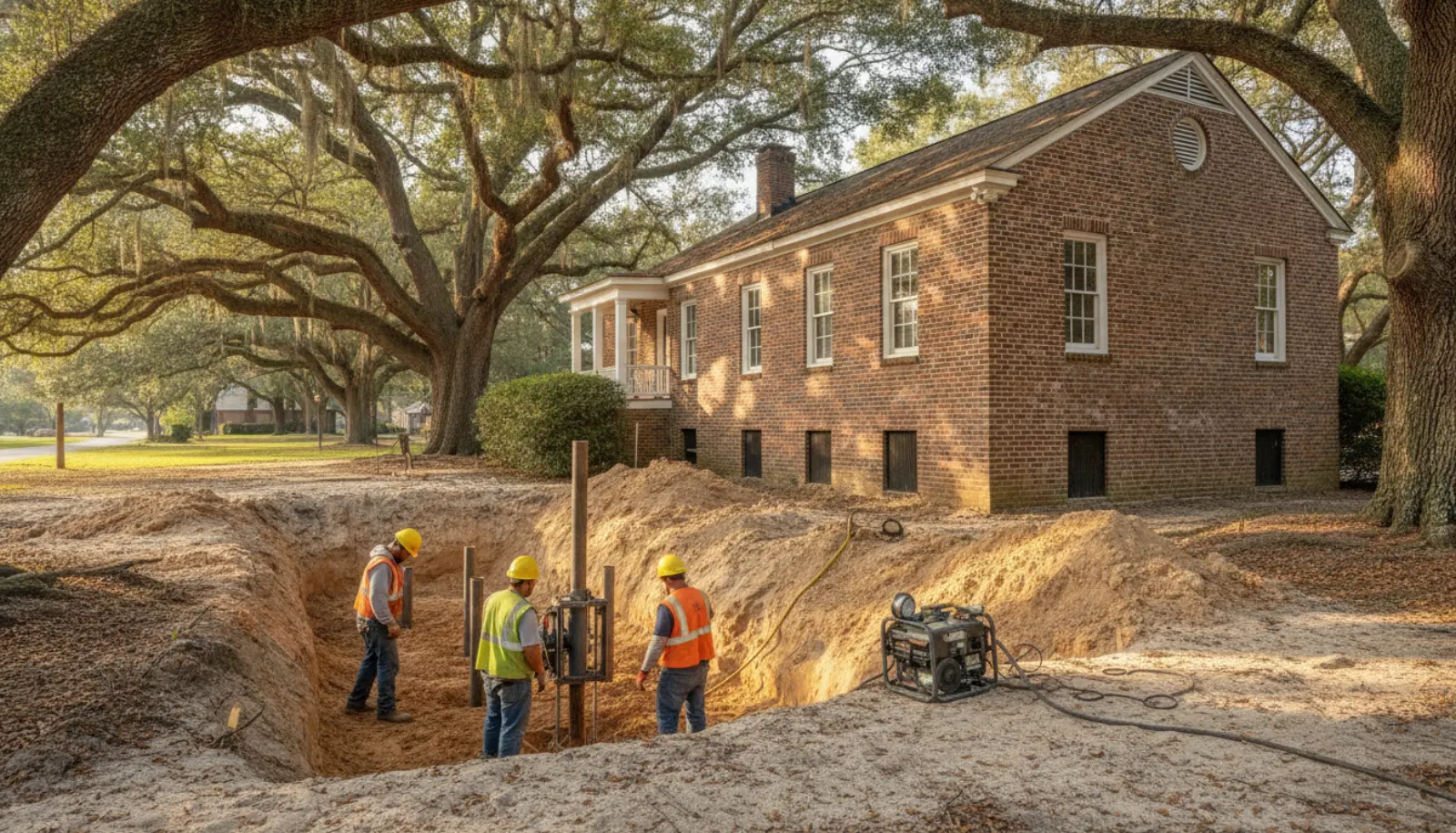
Most old homes here sit on piers. In neighborhoods like Ardsley Park, the Victorian District and Thomas Square, houses sit up off the ground. Piers, often brick, hold wood beams. The beams hold the floor joists. When one of those parts drops or weakens, the floor above it drops too.

The ground is wet. The Chatham County plan calls the county flat and slow to drain, with water close to the top. When the soil under a pier stays soaked, it gets softer. The pier can slowly sink. Piers on the wettest side of the house sink first, so the floor slopes toward that side.

The wood gets wet too. Damp crawl space air soaks into the beams and joists. A U.S. Forest Service lab paper says wood above about 30 percent moisture will decay. Rotted wood crushes and bends. A soft spot near a bathroom or kitchen is often rot from a slow leak.

Some ground was filled. The Ardsley Park historic record says part of it was built on a filled-in bog. Fill can keep packing down for years.

Old framing was built differently. Some older homes have joists that span farther than builders allow today, a point home builders often make about old houses. Over a hundred years, a long joist can sag in the middle.
Cosmetic or urgent?

Usually not urgent:

  • A slight slope that has been the same for years.
  • A slope in an old house with no new cracks or sticking doors.
  • A small hump over a center beam, which is common in old homes.

Call soon:

  • A slope that is new or getting worse each year.
  • A soft or spongy spot that gives when you step on it.
  • A floor that drops near a wall, a tub or a heavy appliance.
  • New cracks, sticking doors and slope all at once.
  • A pier under the house that leans, is cracked through, or has crumbled.

What the fix usually is

The crew goes under the house to find what dropped. Then they fix that part. Most sloping floor jobs use one or more of these:

  1. Add or reset supports. New steel posts or rebuilt piers go under the low beam.
  2. Lift slowly. The beam is jacked up a little at a time so plaster and trim are not shocked.
  3. Swap old shims. Rotted or crushed wood shims are replaced with steel or new supports.
  4. Sister weak joists. A new board is bolted beside a sagging or cracked joist.
  5. Replace rotted wood. Beams, sills or joists that have rotted are cut out and replaced.
  6. Fix the water. If damp caused it, the crew fixes the drainage or the crawl space air too.

Typical ranges are in the cost table on this page. They come from a national cost guide, not a quote. A floor that needs one new support costs far less than one with long runs of rotted beams.

What to do before the inspection

Roll a marble

In each room and note which way it goes.

Use a level app

On your phone and write down readings in the same spots.

Note doors

That stick or swing, and when it started.

Mark crack ends

With a pencil and the date.

Look from the crawl space door

For leaning piers, wet ground or sagging wood. Take photos.

Stay off

Any spot that feels soft.

Frequently asked questions

How much floor slope is normal in an old house?

Most old houses have some. A gentle slope that has not changed in years is common in a 100-year-old home. A slope you can see, feel when you walk, or that is getting worse is worth a look. The inspector can measure it so you have a number to watch.

Why does my floor dip in the middle of the room?

It often means the joists are sagging between supports. Older homes sometimes have joists that span too far. Rot, termites or a dropped pier under the middle beam can also cause it.

Can a sloping floor be made perfectly level?

Not always, and it should not be forced. Old plaster, doors and trim have shaped themselves around the slope. Lifting too far or too fast can crack them. A good crew lifts slowly and aims for solid and close to level.

Is a sagging floor dangerous?

Most sag is slow and not an emergency. But a floor that feels soft, bounces a lot, or drops quickly can mean rotted wood or a failed support. Stay off that spot and get it checked soon.

Should I worry about sloping floors when buying a house in Savannah?

Many historic homes here have some slope. Ask for a look under the house before you close. Find out if the cause is old settling that has stopped or a support that is still moving.

Does fixing the slope fix the doors and cracks too?

Often it helps. Doors may close better and cracks may close part way. Plaster and trim usually still need patching after the house is leveled.

Get your floors checked for free

You do not have to guess what is under the floor. Call (912) 771-1041 or send the short form. A local crew will look under the house, find what dropped, and give you a written price before any work starts.

(912) 771-1041 Free inspection