Skip to content
Savannah Foundation

Serving Savannah and nearby areas

House Settling in Savannah, GA

Some settling is normal, but a Savannah house that keeps sinking on one side needs a fix, so get a free inspection and a written price to find out which you have.

Book a free foundation inspection

Tell us what you are seeing. A local specialist calls you back the same business day.

Local to Savannah

We connect property owners in Savannah and nearby areas, including Historic District, Victorian District, Thomas Square and Midtown, Ardsley Park, Isle of Hope and Thunderbolt, with one independent local foundation repair specialist.

  • Lots of new homes on new fill

    Pooler grew from 19,140 people in 2010 to 25,711 in 2020. Richmond Hill grew almost 80 percent in the same ten years. New homes sit on ground that was cleared, filled and packed, and that fill can keep settling in the first years.

  • Wet, low ground

    USDA soil maps show water at or just above the surface at times in Pelham soil on low flats, and 12 to 30 inches down for months in Ocilla soil. Ground that wet is softer, and a house on it can settle more on its wettest side.

  • Old fill near the marsh

    The Chatham County plan warns that homes on old fill near the marsh face more risk. Capers marsh soil, mapped in the county, is soft and drains very slowly. The Ardsley Park historic record says part of that neighborhood was built on a filled-in bog.

What it costs

Typical published ranges for Savannah. The contractor's written estimate is the price, and the inspection is free.

WorkTypical range
Settling inspection and written estimate Free
Seal or fill a crack $200 to $1,000
Raise a sunken slab section (slab jacking) $500 to $1,900
Slab foundation repair $1,000 to $10,000
Foundation repair in Savannah, small to major $2,200 to $23,300
Piers along a whole side (underpinning) $10,000 to $40,000
Structural engineer report, if needed $300 to $2,000

See typical foundation repair prices in Savannah

Normal settling vs a house that is sinking

Every house settles. The question is whether it settled once and stopped, or whether one part keeps going down. That second kind is called uneven settling, and it is the kind that needs a fix.

Here is what each one tends to look like.

Normal: thin cracks

In drywall corners that show up once and stop.

Normal: a small crack

In a garage or driveway slab that stays flat.

Normal: a nail pop

Or two in the first years of a new home.

Warning: cracks that grow

Longer or wider over months.

Warning: a crack with one side higher

Than the other.

Warning: doors that stick more

Each year.

Warning: a floor that slopes

Toward one corner.

Warning: a gap

Between the wall and the ceiling, or where trim pulls away.

Warning: one corner of the house

That looks lower from outside.

Warning: a porch or steps

Pulling away from the house.

Why houses settle unevenly in Savannah

The ground is wet and soft in places. The Chatham County plan calls the county flat, with soil that drains poorly and water close to the top. Wet soil does not hold weight as well as dry soil. If one side of the house sits on wetter ground, or gets the runoff from the roof, that side can settle more.

A lot of homes are new. The towns around Savannah have grown fast. Pooler went from about 19,000 people in 2010 to nearly 26,000 in 2020. Richmond Hill grew almost 80 percent in those ten years. New homes are built on land that was cleared and filled. If the fill was not packed well, it keeps settling for years after the family moves in. In a slab home, that settling shows up as cracks and sticking doors.

Some old neighborhoods sit on fill too. The Ardsley Park historic record says part of it was built on a filled-in bog. The county plan warns about homes on old fill near the marsh. Marsh soils like Capers are soft and drain slowly. Older homes on that kind of ground can keep moving long after they were built.

Storms speed it up. In August 2024, Tropical Storm Debby dropped about 10 inches of rain on Savannah. Ground that soaked gets soft. Fast water can also wash soil away from the edge of a slab or the base of a pier.

When settling is cosmetic and when it is urgent

Watch it: A few thin cracks that show up and stop. A new home with some small cracks in the first year or two. Mark them, date them and check every few months.

Get it checked soon:

  • Cracks wider than about a quarter inch, or groups of cracks in one wall.
  • A crack that keeps growing after you marked it.
  • New cracks and sticking doors right after a big storm.
  • A slab edge with soil washed out from under it.
  • Several warning signs at once in one part of the house.

What the fix usually is

The fix depends on why the house is settling and what it sits on.

  1. Fix the water. Gutters, downspouts and grading often cause the wet side. Fixing them can stop slow settling on its own.
  2. Raise a sunken slab section. For a small area, like a patio or garage edge, the slab can be lifted by pumping material under it.
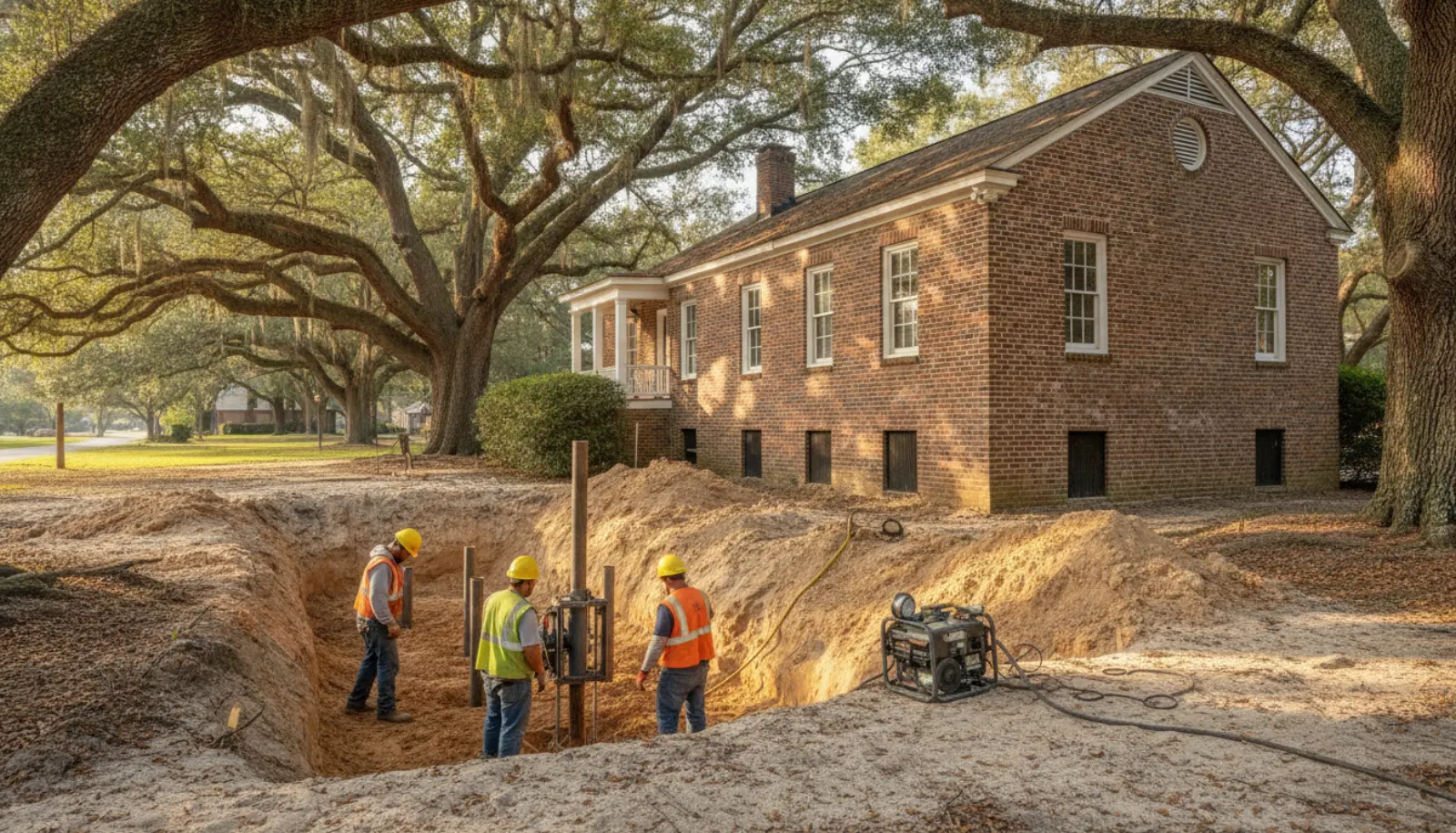
  3. Add piers. For a house that keeps sinking, piers are driven or pushed down to firmer ground. The house rests on them instead of the soft soil.
  4. Reset supports. In a raised house, piers or posts under the low beam are rebuilt or added.
  5. Patch last. Cracks in drywall, brick and tile get fixed after the house is stable.

The cost table on this page shows typical ranges from a national cost guide and a Savannah cost study. They are not quotes. Fixing drainage costs far less than a row of piers, which is why finding the cause first matters.

What to do before the inspection

Mark each crack

At both ends with a pencil and the date.

Take photos

With a ruler or coin for scale.

Check after rain

Note where water pools near the house.

List the doors

That stick and when it started.

Find your paperwork

If the home is new, look for the builder warranty.

Frequently asked questions

Is it normal for a house to settle?

Yes. Every house settles a little as the ground packs down under its weight. Most of it happens in the first few years. Small, even settling with thin cracks that stop growing is normal.

How do I know if my house is settling too much?

Watch for change. Cracks that keep growing, doors that stick more each year, a floor that slopes more over time, or one corner that looks lower are signs the house is still moving on one side.

My house is only a few years old. Why is it settling?

New homes sit on soil that was cleared, filled and packed. If the fill was not packed well, or water runs to one side, part of the house can settle in the early years. Check your builder warranty first.

Can a house settle after a big rain or flood?

It can. Soaked ground is softer, and fast water can wash soil from under the edge of a slab or around piers. If new cracks or sticking doors show up after a storm, have it checked.

Will settling show up on a home inspection when I sell?

Signs like big cracks, sloping floors and sticking doors usually get noted. Buyers often ask for a foundation report. Knowing what is going on before you list gives you time to fix it or price it in.

Does homeowners insurance cover settling?

Usually not. National cost guides say insurers see most settling as wear. Damage from a sudden event may be treated differently, and flood damage falls under flood insurance. Ask your agent.

Get your house checked for free

You do not have to guess if it is normal. Call (912) 771-1041 or send the short form. A local crew will tell you if the house is still moving and why, and you get a written price before any work starts.

(912) 771-1041 Free inspection