Skip to content
Savannah Foundation

Serving Savannah and nearby areas

Crumbling or Leaning Brick Piers in Savannah, GA

Brick piers that crumble, crack or lean under a Savannah home are holding up your floor, so get a free inspection and a written price to repair or replace them.

Book a free foundation inspection

Tell us what you are seeing. A local specialist calls you back the same business day.

Local to Savannah

We connect property owners in Savannah and nearby areas, including Historic District, Victorian District, Thomas Square and Midtown, Ardsley Park, Isle of Hope and Thunderbolt, with one independent local foundation repair specialist.

  • Brick made near Savannah

    The Henry Ford museum holds a Savannah Gray brick likely made on the Hermitage Plantation in Chatham County between 1820 and 1850. Local brick has been holding up Savannah homes for a very long time.

  • Raised houses everywhere

    The Historic Savannah Foundation describes the Historic District as full of grey brick houses on raised basements. Ardsley Park, begun in 1909, is all wood-framed houses, says its U.S. historic record. Many of these homes stand on brick piers.

  • Floods wash out the base

    Hurricane Irma pushed the Fort Pulaski tide gauge to 12.24 feet in 2017, says the National Weather Service. Flood water moving under a house can wash soil from around the base of a pier and leave it standing on less.

What it costs

Typical published ranges for Savannah. The contractor's written estimate is the price, and the inspection is free.

WorkTypical range
Pier inspection and written estimate Free
Repoint brick (new mortar) $3 to $15per sq ft
Pier and beam foundation repair, most jobs $2,000 to $15,000
Crawl space foundation repair $2,500 to $12,000
Replace a support beam $1,500 to $5,000each

See typical foundation repair prices in Savannah

What you will notice

You may not see the piers until you look under the house. But you will often feel the problem first in the floor above.

A pier that leans

To one side.

Cracks running through the brick,

Not just the mortar.

Mortar that crumbles

Or turns to sand when you scrape it.

Loose or missing bricks

At the base or top.

A gap

Between the top of the pier and the beam.

Crushed or rotted wood shims

On top of the pier.

Soil washed away

Around the base, so the footing shows.

Water lines or stains

On the brick from past flooding.

A soft or sloping spot

In the floor right above it.

Why brick piers fail in Savannah

They are old. Brick has been made near Savannah for about two hundred years. A Savannah Gray brick in a museum collection was likely made on the Hermitage Plantation in Chatham County between 1820 and 1850. The Historic District is known for brick houses on raised basements. Ardsley Park, begun in 1909, is all wood-framed houses. A hundred years or more of weight and weather wear out any pier.

The mortar wears away. Old brick was laid in soft lime mortar. It is meant to wear before the brick does. But after many decades of damp, the joints get soft and sandy. Once the mortar goes, the bricks shift and the pier loses strength.

The ground stays wet. The Chatham County plan calls the county flat and slow to drain, with water close to the top. A pier footing sitting in soaked soil can sink a little at a time. One sinking pier is enough to make the floor dip.

Floods and big rain. Hurricane Irma in 2017 and Tropical Storm Debby in 2024 both put a lot of water on Savannah. Water running under a house can wash soil from around the base of a pier. It also soaks the brick and the wood on top.

Bad patch jobs. The National Park Service warns that new mortar must be softer than the old brick. Hard mortar on soft old brick can make the brick crack and flake. A pier that was patched the wrong way years ago can fail faster.
When it is cosmetic and when it is urgent

Usually not urgent:

  • Mortar that is worn on the surface but still hard inside.
  • A pier that stands straight and still touches the beam.
  • Small chips on the corners of old brick.

Call soon:

  • A pier that leans or looks like it could tip.
  • A crack through the brick from top to bottom.
  • A gap where the beam no longer rests on the pier.
  • A pier with bricks missing or falling out.
  • Soil washed out so the base is exposed after a storm.
  • A soft or sinking spot in the floor above.

What the fix usually is

The inspector looks at each pier and the beam on top of it. Then the fix fits the problem.

  1. Repoint. If the brick is sound, the worn mortar is cleaned out and refilled with mortar that will not harm old brick.
  2. Shore the beam. Before a pier comes out, the crew sets temporary supports so the floor does not drop.
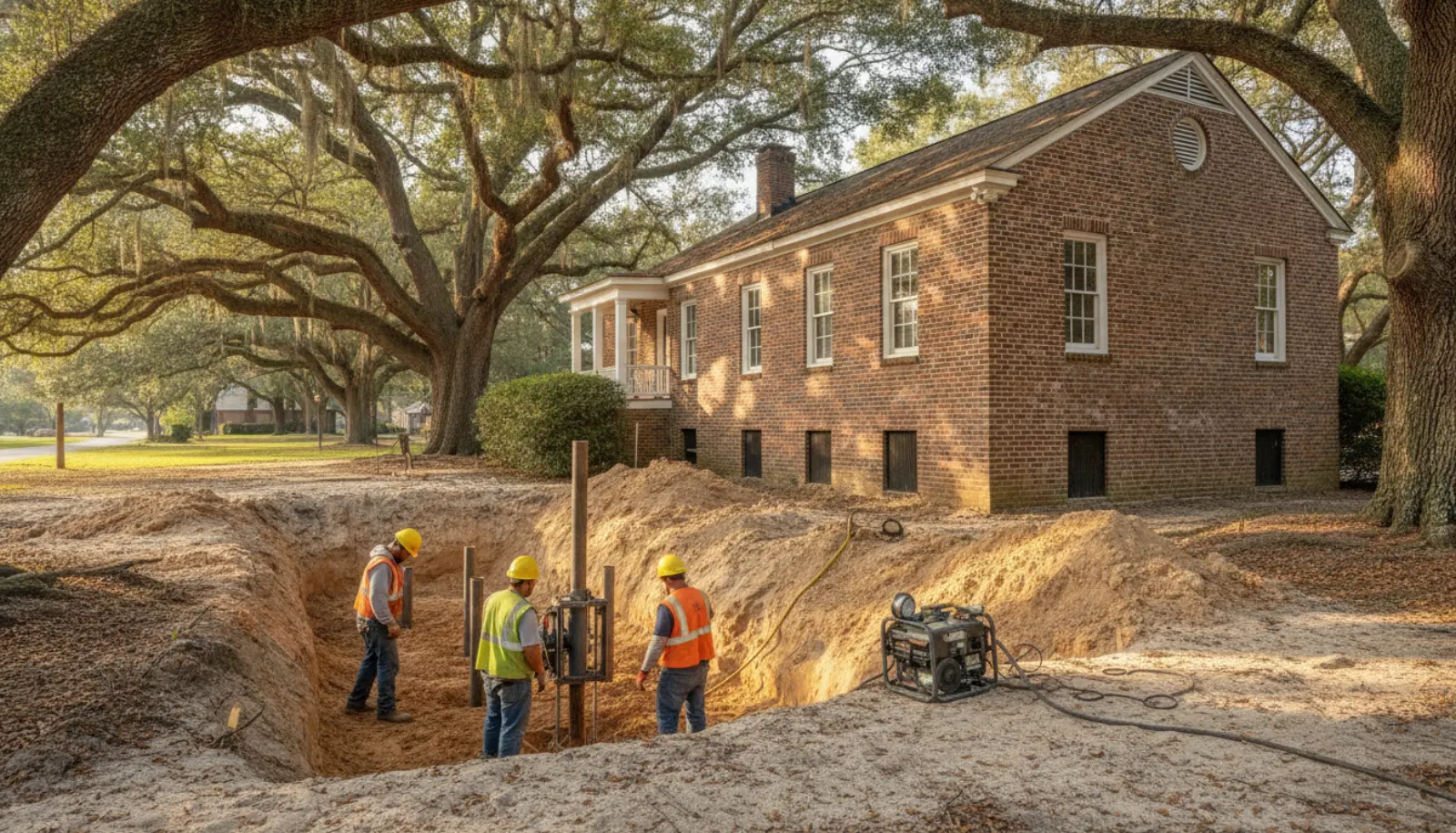
  3. Rebuild the pier. A failed pier is taken down and rebuilt, often on a new footing. Some crews use new brick, some use block, some use steel posts you can adjust.
  4. Fix the top. Rotted wood shims are replaced with steel shims or an adjustable cap.
  5. Lift slowly. The beam is raised back into place a little at a time.
  6. Fix the water. Drainage and crawl space moisture get fixed so the new pier stays dry.

In flood zones outside city limits, the Chatham County flood law counts permitted repairs over five years. If they add up to half the home's value, the whole home must meet today's flood rules. Ask how that applies before a large job.

The cost table on this page shows typical ranges from national cost guides. They are not quotes. One pier costs far less than a row of them with rotted beams on top.

What to do before the inspection

Look from the access door

With a flashlight and take photos of each pier you can see.

Note any lean

And any gap at the top.

Do not hit, kick or pull

On a loose pier.

Keep heavy things

Like a piano or a full bookcase off a floor that is dropping.

Write down

If things got worse after a storm.

Frequently asked questions

How do I know if a brick pier needs repair?

Look for a lean, a crack that runs through the brick, mortar you can scrape out with a key, bricks that are loose or missing, or a gap between the top of the pier and the beam. Any of those means the pier is not carrying its full load.

Can old brick piers be repaired, or do they need to be replaced?

Piers with worn mortar but solid brick can often be repointed. Piers that lean, crack through, or sit on a sunken footing usually need to be rebuilt. Some crews replace them with concrete block or adjustable steel posts.

Why is there a gap between my pier and the beam?

Either the pier sank or the old wood shims on top rotted or crushed. Either way, the beam is no longer resting on it. That spot of floor is unsupported and will sag.

Is a leaning pier dangerous?

It can be. A pier that leans is pushing sideways instead of straight down, and it can fall over. If one is leaning badly, keep heavy loads off the floor above it and get it checked soon.

Should new piers match the old brick in a historic home?

Piers you can see from the street often matter for historic review in Savannah. Piers hidden under the house have more options. Ask the preservation staff at the planning office before you start, and ask the crew what they have used in your district.

Get your piers checked for free

The piers are what hold your house up. Call (912) 771-1041 or send the short form. A local crew will look at every pier, tell you which ones need work, and give you a written price before any work starts.

(912) 771-1041 Free inspection